We built a leaderboard, not a match
Years ago I sat with the data behind a dating product I had helped build. Thousands of people, all hoping to meet someone. And when I actually looked, a small handful of them were getting almost all the interest, and everyone else was getting almost none.
Nothing was broken. The system was doing exactly what we built it to do: take a person, score everyone else against them, put the best on top. It was good at that. It just meant the same few people rose to the top of everyone's list, and the rest quietly waited.
I remember the uncomfortable thought. We hadn't built matching. We had built a leaderboard.
The costume
A leaderboard answers one question: given this person, who fits best? Score everyone, sort, done. It feels like matching. A ranked list of "your top matches" looks exactly like the real thing.
Real matching answers a harder question: given what everyone wants, and the fact that nobody has infinite room, who should actually be with whom? Not "who is best for you," but "who is best for each other."
They look identical from the outside. The gap shows up in four places, and if you have used any of these products, you have felt all four.
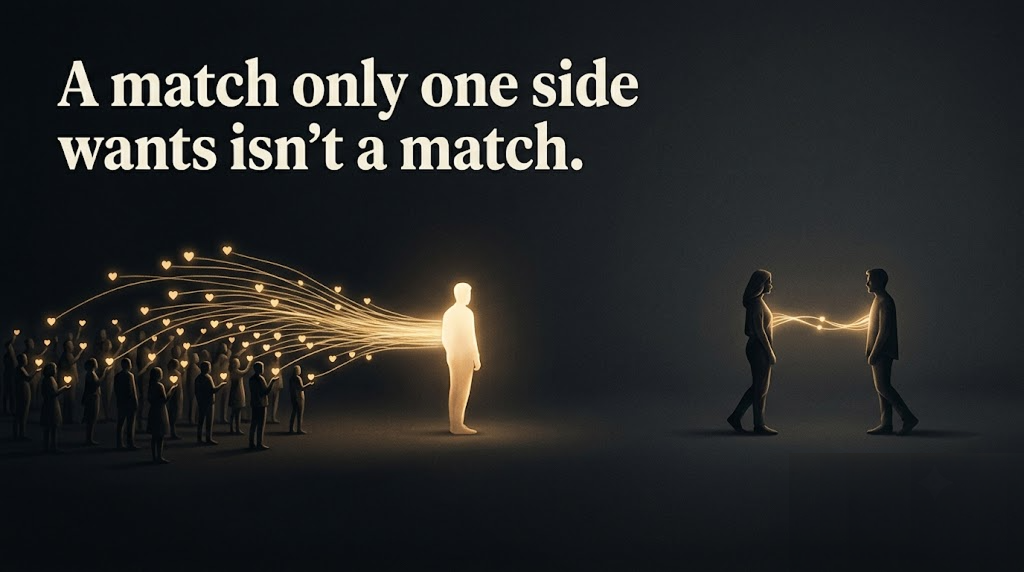
It only listens to one side. A leaderboard asks who fits you. It never asks whether they want you back. A match that only one side wants is not a match. It is a rejection with extra steps.
It piles everyone onto the few. Rank a whole pool against one ideal and the same names sit at the top of everyone's list. The most-liked profiles get flooded. Everyone else gets silence. The individual rankings are all reasonable, and together they send the entire room to the same door.
It ignores capacity. The most-wanted person cannot say yes to everyone. The best candidate cannot take every job. A leaderboard has nothing to say about this. Real matching is mostly about exactly this: who steps back for whom, so the whole set of pairs actually holds together.
It forgets what happened. A leaderboard scores hopes. Matching cares about outcomes: who replied, who met, who was still glad about it months later. That feedback is the entire point, and a sorted list throws it away.
The frustrating part is that this is solved
None of this is new or waiting on better AI. In 1962 two mathematicians, Gale and Shapley, proved you can always pair two sides so that no two people would both rather have each other than what they ended up with. It is called a stable matching. Refined by Alvin Roth, it is how every graduating medical student in the United States is placed in a hospital, how donor kidneys travel down long chains to the people who need them, how children are assigned to schools.
It won the Nobel Prize in economics in 2012. It is over sixty years old. And almost nothing that markets itself as an AI matchmaker uses any of it.
Why the leaderboard keeps winning
Because AI made it cheap. You can now score any two things against each other with a sentence of plain English and a model call. So everyone ranks, more smoothly than ever, and calls the sorted output a match.
But a better leaderboard was never the scarce thing. Ranked lists were always easy to produce and easy to believe. The scarce thing is the layer above it: the part that takes two sides with their own wants and limits and produces pairings that are mutual, that spread across the whole pool instead of piling on the few, and that hold because both sides would choose them again. That layer is where the real work is, and it is the part you cannot get from a good prompt.
I spent the years after that moment trying to build the other thing. The part that asks not who is best, but who is best for each other. Where both people have to want it. Where the popular few cannot absorb everyone. Where the pairing holds because neither side would trade it.
If you have ever been the perfect match who got ghosted, you already understand it better than most of the products claiming to fix it. A match only one side wants was never a match. It was a leaderboard, and you just were not at the top of it that day.
That is the problem I still work on. If it is yours too, I am easy to find.